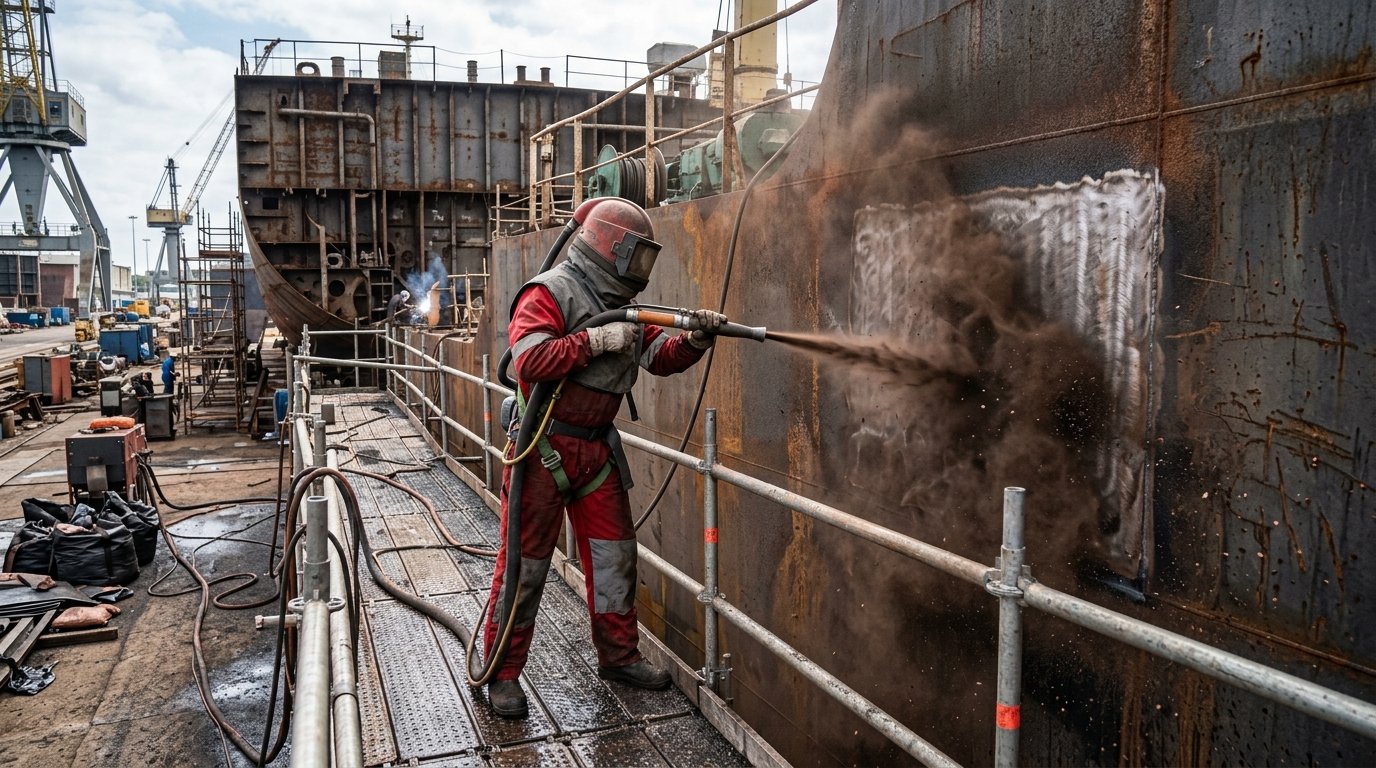
Surface preparation accounts for over 70% of premature protective coating failures. Painting over mill scale, rust, or chloride-contaminated steel results in rapid blistering and catastrophic delamination under aggressive maritime, chemical, and industrial environments.
Why Copper Slag is Preferred Over Silica Sand
- Health & OSHA Safety: Traditional beach or river sand contains free crystalline silica, which causes fatal silicosis in blasting operators. Copper slag contains less than 0.1% free silica, making it non-hazardous, eco-compliant, and compliant with international shipyard safety rules.
- Superior Cutting Power: With a Mohs hardness of 7.0 and sharp, faceted, angular particles, copper slag cuts through thick marine epoxy coatings, heavy rust, and forge scale twice as fast as sand.
- Optimum Anchor Pattern (Profile): Yields a uniform anchor tooth profile between 50 and 100 microns, complying with ISO 8501-1 SA 2.5 and SA 3.0 standards for marine coatings and primer adhesion.
Technical Properties of Repuls Copper Slag
- Hardness: 6.5 – 7.0 Mohs Scale
- Specific Gravity: 3.2 – 3.8 g/cm³
- Moisture Content: < 0.2% oven dried for clog-free nozzle metering
- Chloride Content: < 25 ppm (Strictly marine compliant)
Repuls Copper Slag Supply:
Supplied in 50kg bags or 1-ton jumbo bags from Chennai facility with fast shipping to shipyards, ports, and structural fabrication complexes.